V. The Demented Communist Mind of Antonin Scalia
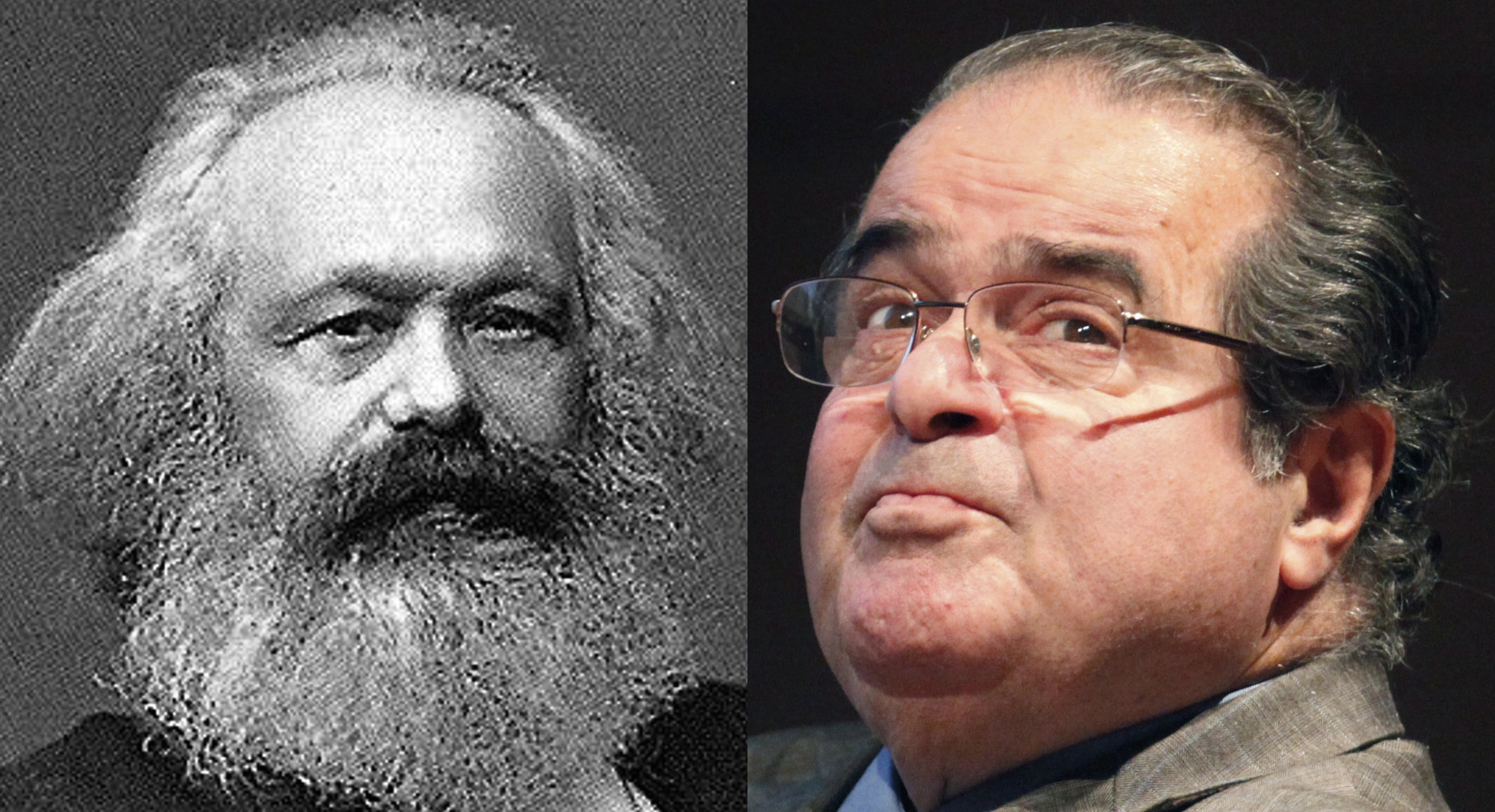
Antonin Scalia didn’t like the independent counsel statute (1978 Ethics in Government Act) as a policy (or maybe as a specific case). In reality he doesn’t like it because it interferes with the operation of his hallucinated collective mind (which all real-world processes do). But Scalia doesn’t directly say that in Morrison v. Olson, and neither does any law.
So to say the statute was illegal, Scalia had to replace the hard details of our government with incorrect abstractions. To say that an individual prosecutor is either part of the President blob, or part of the Congress blob. To abstract and incorrectly redefine what law says, to what he likes. To claim anyone but his preferred communist mind controlling things “violates the separation of powers”.
Because Scalia is unable to resist his reflex to think of a collective mind ordering the world, he has to erase the details of what government employees and written laws and processes actually do, before he can begin thinking about them. He does this by replacing words like “elected legislator”, “judge”, and “written law” with terms like “branch”, “department” and “separated power”. To then incorrectly characterize their nature and interaction, and change what the law is claimed to create. To say the Constitution prohibits anything other than an (elected) utopian autocrat (without interference from vague external forces).
But suppose Joe Sixpack is suing a cop. If he subsequently gets elected to his state’s legislature, his lawsuit doesn’t suddenly become a violation of the separation of powers. (Less so, in proportion as more state committeemen join the suit.) And nor does it violate the separation of powers, if some congressmen are throwing a party and someone calls the cops. Any government employee wants to call immunity “separation of powers”, and claim he is so important that arresting him is illegal.
a. Individual Government Employees as a Blob of Abstract Will
The phrase “separation of powers” isn’t in the Constitution or Declaration of Independence. It’s an abstraction that connotes little more than a committee of more ordinary people deciding preferences separate from a king. The idea is that this group acts separately, often in opposition to the king. It’s understood to refer to a legislature, but leaves out that detail to simply say “there isn’t only a king with power”.
The phrase “separation of powers” is a vague, impressionist observation that two things are different and separated (which described historical observations, but didn’t create what was observed). The word “checks” adds some hint that the separate things interact somehow. This still supplies less detail than the general principle of “preferences being distributed as written laws, and local monitors (judges) verifying that local officers serve those preferences”.
A prosecutor isn’t part of an abstract force of will. The will is the law, he is just the local person enforcing it. The whole point of paid jobs, is to make serving someone else’s preferences dovetail with a person’s own interests. People make french fries for money, not because they like feeding other people. A criminal defendant raises disputes of the law on behalf of society, to the extent they dovetail with his own interests. And a prosecutor has his own goals, that give him an incentive to act as a delegate on behalf of the written law.
But to make sure the prosecutor uses his prison to enforce the written law not his own agenda, we have monitors called courts, and even jurors with the least personal agenda of all. So like the two-key system for missile launches, we have a prosecutor and a “separate” monitor. And they are both separate from this list of preferences in laws, because a piece of paper has no eyes or hands to enforce itself upon circumstances. So a prosecutor enforcing a written law, regulated by a court, embodies the three different functional activities of the separation of powers, in a specific case.
To the extent “separation of powers” describes (1) a prosecutor being regulated by (2) a judge in court to (3) follow the law, a prosecutor in court is not violating the separation of powers just because a committee of people who also write legislation guided his discretion of what (or whom) to investigate (dialed 911). Or because legislators designed the jurisdiction of courts, and the particular scheme of government employees or delegates, in which some prosecution takes place. (All courts and prosecutors, not just the independent counsel, were designed and given laws to enforce by legislators, including to harass executive employees also designed by legislators.)
But Scalia doesn’t visualize individual cases, in which judges regulate police to do what case facts indexed into written law tell them to do (rather than their own agenda). Rather, like Rachel Barkow, Scalia ignores the functional details of process in individual cases, to imagine a more vague interaction of larger forces. Scalia imagines decisions aren’t made at the case level, but at the level of some hallucinated mind. (After which point the individual case outcomes would have to just happen through some unspecified process, but that’s why communists don’t get into details.)
Scalia says a judge regulating prosecutors in an individual case isn’t the “separation of powers”. Rather, some abstract adversarial relationship between vague objects or blobs of social forces (including across multiple cases) – a universal mind and forces external to that mind – is separation of powers. In this manner, the will of the executive-branch blob guiding the discretion of prosecutors (to enforce some subset of the law or even break it), is a separate power. This blob is like a second legislature deciding what to actually enforce, instead of law. (Telepathically, without needing votes.)
So Scalia thinks that some collective mind replacing law with some subset of it or something different, and deciding who should be forced to follow the law — or follow its will, basically eliminating and replacing the role of legislation — is separation of powers. “Separation” means this blob is unencumbered. In this manner, Scalia replaces actual separation of powers with a claim that a collective mind ordering society without any interferences is the “separation of powers”. To claim the Constitution creates a communist utopia.
Scalia simplifies our government to a tribunal of Gods, where like in a myth the virtuous one cast out the other two.
So that a prosecutor enforcing legislation being monitored by a judge in an individual court proceeding isn’t “the separation of powers”. Rather, it’s the entire body of prosecutors being supervised by the President as a single mind, free from interference by written law or people who (also) add new laws. It’s not that there’s three separate roles in the courtroom (more than three). It’s that there’s three separate vague collective minds, interacting like billiard balls in a non-specific adversarial way.
This replaces legislation with the single will of a collective mind, that doesn’t need to vote on or write down or publish the details of what it wants. Because Scalia reflexively degenerates to thinking about a single collective will, and separate forces external to it.
b. Using Abstraction to Erase and Rewrite Details
Scalia’s first arguing step is to create confusion, by erasing the details of what law actual says. Going along a spectrum from abstract terms to detailed terms, we might have something like (i) “separation of powers”, (ii) “checks”, (iii) “preferences, delegates and monitors” (laws, prosecutors, and judges), and (iv) a specific prosecutor getting paid to investigate some law violations.
Scalia chooses the vaguest one, “separate”. So that he can use the vagueness to redefine “separate”, to mean that other people’s activities can’t touch the king; they have to stay separate (the opposite of checks), so they can’t interfere with the king doing what he wants to do. In whatever way Scalia wants to say, If Scalia doesn’t like it.
The Constitution goes the other way, it provides specific elements of processes and the people who participate in them. We don’t need abstractions when we have details. We don’t have to talk about “the executive, legislative, and judicial branches” as abstractions because we know exactly what individual people do. We are not helped by describing them, or thinking about them as vague abstract descriptions with less functional meaning. (Not unless we want to insert our own meaning.)
If the Constitution said “shoes”, we wouldn’t replace that with the more abstract word “objects”. And then find some quotes about the nature of objects, and end up wearing a hat on our feet and calling it the law. If legislators say the President can’t fire some manager, he can’t. (This is true of state governors, local cops, individual citizen petitioners, state electors, Congressmen, and local laws.)
But Scalia doesn’t care what a specific person actually does, rather that he’s a “member of” an abstraction. And if it’s not clear what abstraction — what “branch” — he’s a “member” of, then it must be illegal. (I have watched prosecutors in court, and their being a “member” of something is irrelevant to what they are doing. Except as a substitute for and license to break the law.)
Pretending specific people and processes are abstractions is a step to replace them with incorrect abstractions, and then define those as meaning the communist utopia in Scalia’s mind. To turn actual processes into adversarial blobs, and then say the only blob that has hands to do anything can’t be opposed. Scalia removing details of function is a way to create confusion, so as to smuggle in a communist agenda.
But it’s a trick that works, because Scalia’s opponents don’t say something like “a shoe is more detailed than an object so the law can’t be interpreted as saying hat just because it mentions an object, and there is no collective mind”. They just say “the word hat is not in the Constitution”. Leaving Scalia’s crazy logic upon abstractions. and the hallucination it serves, intact.
c. Harassing Important Jobs (Immunity)
Separation of powers isn’t the real issue in Morrison v. Olson, immunity is. A prosecutor harassing the President so that he can’t do his job is not violating the separation of powers, rather it’s an immunity tradeoff.
Law is tradeoffs. There’s a benefit from ticketing people for littering. But not for ticketing a mother for littering, on her way to the hospital to give birth. And given the probabilistic nature or uncertainty of criminal guilt at different stages of investigation, there’s even less benefit for making someone stop and answer questions to find out if he was littering, on his way to the hospital.
The underlying idea is that going to the hospital is more important than not littering. And by shifting the decision to the cop by saying a cop can stop anyone any time, you’re shifting the policy decision from the discretion of someone who gives birth to someone who reduces littering. From a more important value or activity to a less important one.
This is a basic immunity argument. If a person has a really important job and he’s the only one doing it, and if another person can come along and drag him into court, that other person can influence his ability to do the job and his choices. This shifts the policy decision slightly to the person who uses discretion to investigate and prosecute him, favoring competing (less important?) values.
And even more so, because a cop can choose whom to arrest for littering. So there can be multiple people littering, or the target isn’t even littering. But a cop harasses a specific person not to reduce littering but to change the policy that his target is supposed to decide. Like they arrested me for posting “Cops2Prison.org” fliers, and lied in court to say it was something else.
Immunity is the opposite of separation of powers. It’s saying some activities are so urgent and some laws so trivial, that we don’t have time to have a separate person review if they’re following the law. Separation isn’t cost-justified in these situations, it’s unprofitable. Immunity isn’t written in the Constitution in a general way, though it’s created in specific ways like for speech and guns. (Nobody demanded an executive-branch bill of rights.) But immunity is a practical calculation implied in any scheme of government.
But it’s up to legislators to do that calculation and make that argument, not judges. And legislators calculated that the independent counsel statute was on-balance beneficial. So Scalia dodges making that immunity argument (and not even being allowed to make it), by conflating executive-officer immunity as being equal to separation of powers. All Scalia’s really saying is calling executive-officer immunity separation of powers even though it’s the opposite. To pretend the Constitution legislated immunity when it created “separate branches of government”.
You can criticize the independent counsel policy without needing nonsensical separation-of-powers mumbo-jumbo. Pretending it’s separation of powers was a trick by Scalia, to pretend a bad policy was illegal, because it violates separation of powers and the Constitution makes that illegal. But the Constitution doesn’t make prosecuting government employees illegal. Scalia disliking external forces which operate adversarial to his collective mind makes it illegal.
The independent counsel statute may or may not be bad policy. Considering that the target might be doing his policy in an important subject that nobody else is working on. The target could actually be enforcing laws written by a past Congress. But criminal prosecution being on-balance destructive never bothered Scalia before, for common people who get arrested before there’s a grand jury. Or have their lives ruined or get shot based on the whims of cops who invent fake reasons.
People like Scalia promote immunity based on the general idea that being forced to produce information about their activities is an inefficient thing for a government employee to have to do. In the “chain of dependence” in Scalia’s imagined single mind, this same information is transmitted telepathically to be monitored directly by voters, not needing “separate” monitors in court proceedings.
d. Scalia Not Even Vaguely Right
Let’s suppose the independent counsel law is bad policy. Did Scalia’s mumbo-jumbo enable him to get Morrison right? Was Scalia like a stopped clock that’s right twice a day? Or did his abstractions have some tiny remote correlation to reality, so that the clock was slightly more likely to stop in the vicinity of the right time?
Did Scalia’s analytical approach of abstracting to collective-mind blobs enable him to accurately understand the nature of what was going on and predict the legislature made a bad choice? Because the President would be harassed too much by political adversaries?
No. Prosecutors harassing important people in court who should be immune, and violating separation of powers by not even being regulated in court, are two completely different things. Because you don’t have to be “the executive branch” to be harassed by police and prosecutors, and for this harassment to be unprofitable. But when specifically Congress somehow chooses to do it, it’s more likely to be profitable. Neither “executive branch” nor Congress being involved in some way, automatically makes it unprofitable.
If harassing the President with prosecution is a bad idea, members of Congress choosing to harass the President with prosecution doesn’t make it worse, it makes it better. Because that is a higher level of consensus necessary than just the discretion of a prosecutor, judge, and jury (and a law). The larger a committee of representatives that makes the prosecutorial decision to harass an executive officer, the greater the value of harassing him compared to the costs.
Congress can directly remove the President as a committee — as the actual “will of the pepple” — without even using an external prosecutor in a regular court. If a super-majority of Congress could operate without delegates — without needing judges and prosecutors to do the busy work — there would be nothing wrong with that in the principles of the Constitution.
So both being regulated by law in court, with the addition of Congress wanting it, would make the action more likely to be profitable considering immunity arguments. Not less because it’s Congress.
Maybe they don’t want Joe Sixpack in the street suing the President and making him come in for depositions. But if we honestly tried to follow Scalia’s logic, we would say government employees should never be regulated by courts and laws and petitioners, only by voters in direct democracy.
But Scalia thinks that only someone who’s part of the single executive-branch mind can suffer from being harassed by a prosecutor. Or it’s only unprofitable when executive employees are harassed. Or more unprofitable when Congress chooses things. Scalia really believed it was separation of powers not immunity, based on some blobs, when it’s the opposite of both. Abstracting to blobs destroys your ability to analyze and weigh the tradeoffs rationally.
It’s the opposite of violating separation of powers because it’s adding a check from Congress. And it’s the opposite of immunity because Congress wanting it makes it relatively more not less valid or important.
Scalia doesn’t like the independent counsel statute, because he sees it as an external force interfering with his collective mind. The abstraction is similar to the real world, in that people being harassed by police can have detrimental effects. Scalia could simply say that prosecutors harassing certain officers is on balance a net loss-making activity. But that would be a policy disagreement, and Scalia wants to say the Constitution prohibits it.
Scalia’s mumbo-jumbo wasn’t any kind of policy analysis, it was just bizarre sophistry to try to say that what he wanted was law. Which would only be true if the separation of powers creates a communist utopia. It’s the same thing they do with “states’ rights”. They use any nonsense to say nobody can interfere with cops doing what they want.
Scalia’s analysis wasn’t orthogonal but contrary to reality. Legislators creating and regulating executive offices (and designing optimal regulatory processes) is the whole point of our government.
e. The Uncartoonified Details of What Government Does
Let’s take a moment to look at how government actually works. What the “separation of powers” does is delegates an individual to represent the preferences of a committee upon local circumstances. And also sends a separate person – “the judicial branch” – to independently verify that the individual delegate is representing the preferences of the committee and not his own. And because a legislature (or a list of legislation) has preferences in many areas, many delegates are needed. (Such as in both foreign affairs and criminal prosecution, in France, England, Cleveland, and Kentucky.)
The committee (legislature) ultimately just produces a list of preferences. This written list cannot execute or enforce the preferences, only a person can. A list cannot monitor whether that first actual person is executing the preferences, a second actual person called a judge can (or a court acting on a petition to enforce the law). No one person can do too many things, much less can a committee. A committee that runs around and tries to do random things the same as a President, can only do a limited set of things effectively. That’s why the Continental Congress created a President and other secretaries.
The end goal is to execute the list of preferences written as legislation. (Even if all the legislators died, or did something else all day.) If the preferences could execute themselves, without needing human hands or a monitor of those hands, there would be nothing unjust or tyrannical about it. (For example, every person would be in prison exactly as the law specifies.) Legislators can’t use their own hands to apply those preferences to millions of instances of local circumstances. But if they did, it would not be unjust.
The problem is not that a legislature doing whatever gets a supermajority vote is unjust. It’s not that a list that “concentrated” both powers, a) of being writing on paper and b) doing things, would create tyranny. It’s that it’s not practical for a committee to actually do things by interacting with the world in real time, rather than in theory. And it’s not even possible for writing on paper to do things. The reason we have local prosecutors (and judges) is not to stop laws from being unjust. We have these other “branches” (actor and monitor) because neither writing on paper nor a single committee can prosecute thousands of people all over the map. Or make sure actual prosecutors follow the law.
We can have thousands of local government employees to act upon local circumstances. But all the local people who can act upon local circumstances, don’t do useful things unless they are guided by legislation, and monitored to make sure that they are. It’s not the human actor being “separate” from the list that makes it just. It’s the human actor following the list that makes his action just. Which again, a committee (or an old list) as a practical matter is not nimble and local enough to accomplish.
We add hands not to create something “separate” from the list or committee, but because we need local hands. If a list cannot do things, we need something separate from it that can.
f. Scalia’s Sleight-of-Hand Switching to Abstractions
Scalia starts his dissent in Morrison v. Olson, by recounting this inescapable reality of needing doers and monitors to enforce laws, as observed by legislators in Massachusetts. Who observed that a written list of laws can’t execute themselves upon local circumstances, or monitor their execution. Scalia quoted them saying “the legislative department shall never exercise the executive and judicial powers, or either of them”.
Notice that the word “department” begins to throw out the details of reality, to say a legislature (the list, individual people, votes?) is just a nondescript “department”. All the various activities of individual legislators and old papers, just became a single mind. In a moment Scalia will use this to say a legislature has the same properties as a monarch, because they’re both “departments”.
Scalia then makes the jump to saying that committees not being able to enforce and monitor laws all over map isn’t an inescapable reality, but “the absolutely central guarantee of a just government”. That’s not what anybody said, and they are crazy idiots if they did. Scalia is talking about a monarch, as the “department” which must have powers separated to not be tyrannical. Not Congress.
(This is like Rachel Barkow seeing criminal process not as a reality of the need to use information, but an arbitrary tax to create justice.)
Scalia jumps to something completely different which Madison said in Federalist 47, that a person doing whatever he wants, rather than serving laws and being monitored in courts to make sure that he serves laws, doesn’t do anything useful. Laws being unable to execute themselves is not “the guarantee of a just government”. Actual humans being forced and confined to execute laws is the guarantee of a just government.
Madison is just saying that a human actor on his own, not following the list or being monitored, doesn’t do anything just. Nobody had ever had a problem with a legislative super-majority being unjust, but with a king and local strongmen being unjust. Nobody ever had a problem with a prosecutor enforcing legislation on another person, monitored by a court, being unjust.
A legislature and a monarch are not simply two conceptually interchangeable “departments”. A “concentration of powers” in a legislature is not the same thing as a concentration of powers in a monarch, which is what everyone is talking about. Nobody had a problem with written laws magically being enforced without separate delegates, but they can’t be.
g. The Independent Counsel in the Cartoon
Now that Scalia had two adversarial collective minds that nobody would untangle, he had to endow one with magical powers. To set up his logic that attacking those powers is bad. But describing what our government does in a little more detail, breaks Scalia’s hallucination.
Does a President have special capabilities? The office of the President is more a social circle, like a small legislature without formal votes and written records. Chosen indirectly, by a person who is elected once every four years (by at least a near-majority of national voters). So it’s a more nimble committee than a legislature, that can address fewer diverse endeavors in detail.
It’s impractical for a committee to even try to do much of anything, in the thousands of local places where things need to be done. Or to try to directly monitor and control the local government employees who do things, without the middleman of courts and written laws. Local government employees doing whatever they want is also a disaster (basically just local wars). And a monarch even trying to control all the local actors (without laws and local courts), is also a disaster. Because it’s almost as impractical for a monarch, as for a legislature to try to directly control all of them. Before the monarch even gets to ignoring law.
The President is different from the written list of legislation. But is he really that different from any other government employee, like a cop or a legislator? Is the President an abstract branch of government, a “department” like the legislature? Or is he just a person with a small social circle trying to do things. Does the fact that we imagine the President as different make him different? Or are we imagining (and trying to create) an unrealistic world. With an entity that can’t really as a practical matter be as different as we imagine he can.
The idea that the independent counsel is not accountable the way the President is, relies on a false cartoon of accountability through the “unitary executive” “chain of dependence” that doesn’t actually exist.
It’s only when you begin with the false imagination that the entire government can run through the President, or that you should try for it to, that the independent counsel interferes with what you imagine you are doing (and disastrously try to do). Otherwise, you realize the independent counsel is just prosecuting a single official, not “the executive branch”. The way any prosecutor prosecutes another person who is doing his own things, taking care of his own business.
It’s the same idea as prosecuting the Ambassador to Chile. The President has more duties and responsibilities than the ambassador to Chile (including declaring smaller wars without Congress). But saying he has so many powers that prosecuting him or his supposed employee ruins government, already ruins government the moment you incorrectly imagine he can have so many powers or should. You’re not prosecuting God, and if you try to have a government run by God, you’ve got bigger problems.
When one prosecutor prosecutes another person in the executive branch — another government employee — he’s not prosecuting the single mind of God. It’s fair to say the President is big and unique enough, that prosecuting him (for small crimes) creates problems. But to say that prosecuting some other officer attacks the President or his supposed universal control, relies on some sort of incorrect impractical assumption of a single mind.
By falsely attributing some sort of all-knowing character to the President, you also overestimate the power or effect of the person prosecuting him (or his supposed direct employee). People may think the President can singlehandedly see and administrate all of government. And in fact as a practical matter under current law, the President may be able to step in and interfere wherever he wants. And the media may like talking to him. It’s fun (and also disastrous) for everyone to pretend and imagine the President is running everything through this conversation.
But the President is hobbled by the unworkable nature of this God-scheme, before the independent counsel can hobble him. As seen with the current President Trump, who flounders around in a series of endeavors he is unqualified to meddle in, from tariffs to improvements of parks and monuments to threatening media companies that criticize him. (This is a generic never-ending story, in every nation where everyone is always disappointed in their leader. They blamed the previous President for ignoring law to let immigrants break it, so that the current President ignores law to fix it.)
Neither the authority to prosecute people, nor any other function in a specific domain or region, is given to “the executive branch”, but to a local domain expert. By harassing the President you are not harassing these functions, and by harassing these functions you are not harassing the President. Except to the extent the President has an ill-advised power to meddle in everything, and put on a theater for a media mob while doing it. Which theater for a mob is not any kind of functional government, and cannot effectively determine and implement useful policy details in specific areas.
The President is not the supervisor of every local prosecution. And pretending he can be, becomes a disaster long before the special counsel supposedly interferes with something it’s not practical to do in the first place.
Yes, the Founders thought (and feared) that the President would be powerful. But no plan, desire, or imagination, can change the smallness of what functions the President can actually do well. This is the actual objection to a king, not that he violates the constitution, but that he doesn’t do what he does, well. People didn’t like monarchy because it became impractical and produced worse results, regardless whether law calls for it or not. Law responds to discovered practical realities.
Scalia really believed the Constitution created this communist autocrat. Though necessarily in a mushy confused way because it doesn’t. All doubt was pushed aside, by pointing to elections every four years as completely transforming and curing the character of this autocrat. So you have a single mind, and it’s not a communist autocrat but something magical by the magic of being elected every four years. And then after that tiny piece of logical assertion, it’s all sophistry and confusion.
I don’t know why Scalia thought a legislature was needed. Maybe to list the things that individuals outside government could be prosecuted for. Maybe to legislate the process required before the unitary mind could take away individual liberty. But Scalia spent his life arguing that individual liberty could also be decided by a single will without process. (Exempting businesses and money which Scalia thinks need to be protected from the collective will.)
h. Failure to Debate and Discredit the Nonsense
So Scalia’s logic is that because the Constitution creates a utopian collective mind, the independent counsel statute must be illegal because it interferes with that collective mind. But Scalia doesn’t say “because the constitution creates a collective mind, the independent counsel statute is illegal, because it interferes with that collective mind”. Instead, Scalia says that elected legislators are the arm of an abstract “department”. And “separation of powers” simply states that there are separate abstract departments operating in an abstract way.
Scalia then says that if in this imaginary cartoon one person was running the government, and if another person (“the legislative branch”) attacked him, then neither person would be running the government. Or the second person would be. Or who even knows, because it’s an impossible nonsensical idea that can’t actually be pictured. Not using actual people in a realistic world.
Scalia conflated the executive branch and local prosecutors as a single mind. And conflated Congress as a list of laws, as the committee that adds to the list, and as elected congressmen who do things other than write laws, as a single mind. Scalia was able to imagine government employees acting against the President were acting as part of a competing collective-mind “department”. Even though they’re not actually writing legislation. And Scalia’s opponents let him fluidly invent forces and dynamics of the interactions between these vaguely-imagined single objects, to support a result.
And then Scalia found historical participants in US government who either lived under, observed, or wanted a king, to say an elected king must be what they understood themselves to be consenting to. And they never consented to checks on that collective will, except as specifically enumerated. Scalia’s discovery of a tool or magic act — “originalism’ — that vaguely worked by coincidence to get the result he wanted, was not his real reasons. The tool did not dictate the result, the result dictated the tool. His real reasons were simply that he’s a communist.
The reason Scalia was able to get away with this, why the incredible stupidity and confusion of what he really believed was never confronted, is because of two things:
1) Scalia’s opponents basically accepted the idea a collective mind could supervise the government through the President, but with a few modifications.
2) All the crap Scalia pieced together was too screwed up to reveal what he believed, or any coherent set of beliefs and create a coherent attack surface. (Nobody new what shell the ball was under, and the majority didn’t care.)
Attempting to trace Scalia’s reasons as the cause of his decisions was backwards. He imagined a single mind in the President, and he tried to explain that out of what legislation actually says. There was an intermediate step where he substituted abstractions and got confused as to what he was even talking about, making it impossible for anyone else to know. Whether Scalia’s reasons passed as making enough sense, depended on whether you wanted the same thing. But if his reasons didn’t make sense, people said “your reasons don’t make sense”. Not “stop inventing crazy crap to get a communist executive”.
Scalia’s reasons were mush and sophistry passable to idiots who also wanted a utopian executive. And his reasoning was so bad that by arguing with it, you could only end up arguing with a ghost. Instead of just saying “don’t make up random crap to promote a utopian communist executive.” Like Scalia could say “The Constitution says we have a President to do good, and therefore he should be able to do whatever he wants.” His opponents would scratch their heads about the logic of that and where it says that. And people who want a utopian communist executive would quote him as a genius.
People who are confused and have no idea what they’re talking about, will grab onto the first thing with any semblance of logic, like a lifejacket in the ocean. If you also want a utopian executive, and from there your thinking goes downhill where you are confused how government even works and lost trying to argue that the Constitution says this, whatever crap Scalia is able to come with really is impressive. Compared to your own efforts to say anything to explain it all. Scalia had an inventory of clever quotes the average idiot never heard before.
There was nothing coherent for Scalia’s opponents to see, so they attacked small local bits. Like simply saying that “the unitary executive” is more than the actual text of the Constitution will bear. Rather than saying “this is all nonsense”. Rather than saying there is no single mind, and everything else Scalia says is mush and sophistry.
When Scalia starts saying that Madison said the guarantee of justice is that “the legislature department” (legislation? some legislators?) can’t have too much power, nobody thinks to respond “you’re a communist”. Behind Scalia’s logic, is this idea in his mind that the President needs to operate as a single mind and Congress can’t interfere with him. But Scalia doesn’t know how to express that in hard details, nobody does. Because it can’t be rigorously explained in the physical world. And so Scalia resorts to some mumbo-jumbo about what Madison once said. And that is what people end up arguing with or accepting, never getting to the root of the problem.
Scalia created a moving ghost of a judicial theory as a smokescreen, tricking even himself the way Cotton Mather proved to himself the rampant existence of witches. And waved it in front of his opponents like a bullfighter, so that they charged to where he wasn’t. What Scalia was wrong about was not what people who disagreed with him were saying he was wrong about, his law interpretations. Because Scalia didn’t himself know what he was wrong about, meaning where the real debate was.
Scalia was celebrated because of the end result of his decisions, which was to promote a utopian communist executive. Which is always popular. Scalia was not celebrated because the details of his reasons made sense. Quite the opposite, it is because Scalia’s actual reasoning was such nonsensical mush, that he was able to smuggle his communist policies past people. By distracting them with his dumb details of the reasons he gave, rather than saying “the reason I am doing this is to create a utopian communist executive”.
Antonin Scalia was a communist, who really believed in the power of a single mind to enact “the will of the people”. With voters as the eyes, the President as the mind, and local government employees as the hands. Scalia was able to conceal that he was a complete idiot, by speaking in mushy abstractions, and never clearly articulating what was going on in his mind that his individual bits of reasoning were acting in service of. (The contents of Scalia’s mind were too much confused mush to be rigorously expressed and criticized.)
Trying to project some sort of simple physical rules onto powerful people playing complicated games, became a great spot to insert communism by saying this guy should win. But camouflaging it behind some crazy thing that would confuse Scalia’s opponents forever, trying to find an abstract rule in it to beat Scalia’s claimed abstract rule.
It wasn’t enough for Scalia’s majority opposition to just say the narrow detail at the end of Scalia’s nonsense, is more than the text will bear. They should have torn down the whole nonsense.
They knew Scalia was wrong, but they didn’t know why. Confused people can’t attack brazen idiotic liars.
Leave a Reply