Non-Government Formal Procedure – The Form of Democracy that Isn’t Used and Why
Would it be possible for political parties to hold formal trials of what elected officials actually do? Rather than just see who can lie the loudest on Twitter all day? If formal process works better than pitchfork mobs to decide whom to send to prison, would it also work better for education or environmental policy?
Formal process in politics for monitoring government employees outside court will never happen for multiple reasons. It doesn’t suit people’s impulses for informal debate. Voters lack the capacity to monitor thousands of decisions. And voters can’t reward and punish numerous individual decisions using occasional elections.
Elections aren’t how government employees are supervised, and never can be. Understanding why is a thought experiment, that helps to understand the processes we can use.
We generally have three ways to get strangers to do things that serve our interests:
1) Private property owners regulated by prices.
2) Government employees regulated by formal procedure in courts.
3) Government employees regulated by informal social processes through votes.
(And of course private individuals regulated by non-government social processes.)
There’s a fourth form of decision-making that isn’t used: Non-government formal procedure.
Suppose I think President Trump’s emergency tariffs conflict with the values of the Republican Party, of which I am a member. I would file a grievance with the local Republican tribunal stating:
1) Trump’s tariffs are harmful and contrary to the values of our party.
2) Here is why.
This grievance would then be published for public viewing, and a local party official would decide whether the grievance is worth considering, or is redundant with other filings, or whatever. This non-government judge would then publish what he decided to do with the grievance.
If the local party reviewer decided the grievance was worth considering, he would then demand a response from someone delegated by Trump. And most important, he would request discovery, requiring party members with relevant information to produce it.
A panel of local party members would then review the grievance, and publish an opinion on why or why not Trump’s tariff policy violates party values or is harmful or beneficial. Then all the violations of each elected official, the position of the party on each, and the final conclusion that members should or should not vote for a particular official or policy, would be published.
Formal process is required to violate liberties, because most people understand it works better than a pitchfork mob. But politics outside criminal process has generally been a free-for-all, because this is how people like to interact. People like to share opinions as if it’s just a few people around a campfire. Even if this becomes a mess of lies when there are thousands of people.
There’s lots of formal procedure outside government, such as peer-reviewed scientific findings and fatwas. Could formal process work better than a shouting competition for things other than putting people in prison, like maybe for education or environmental policy?
The best use for non-government formal procedure, might be to bring local grievances to the attention of party members outside courts. For example, to raise treatment by the EPA of a specific polluter or body of water, to address a party member being harassed by police, or to give appropriate attention to other local harms and violations.
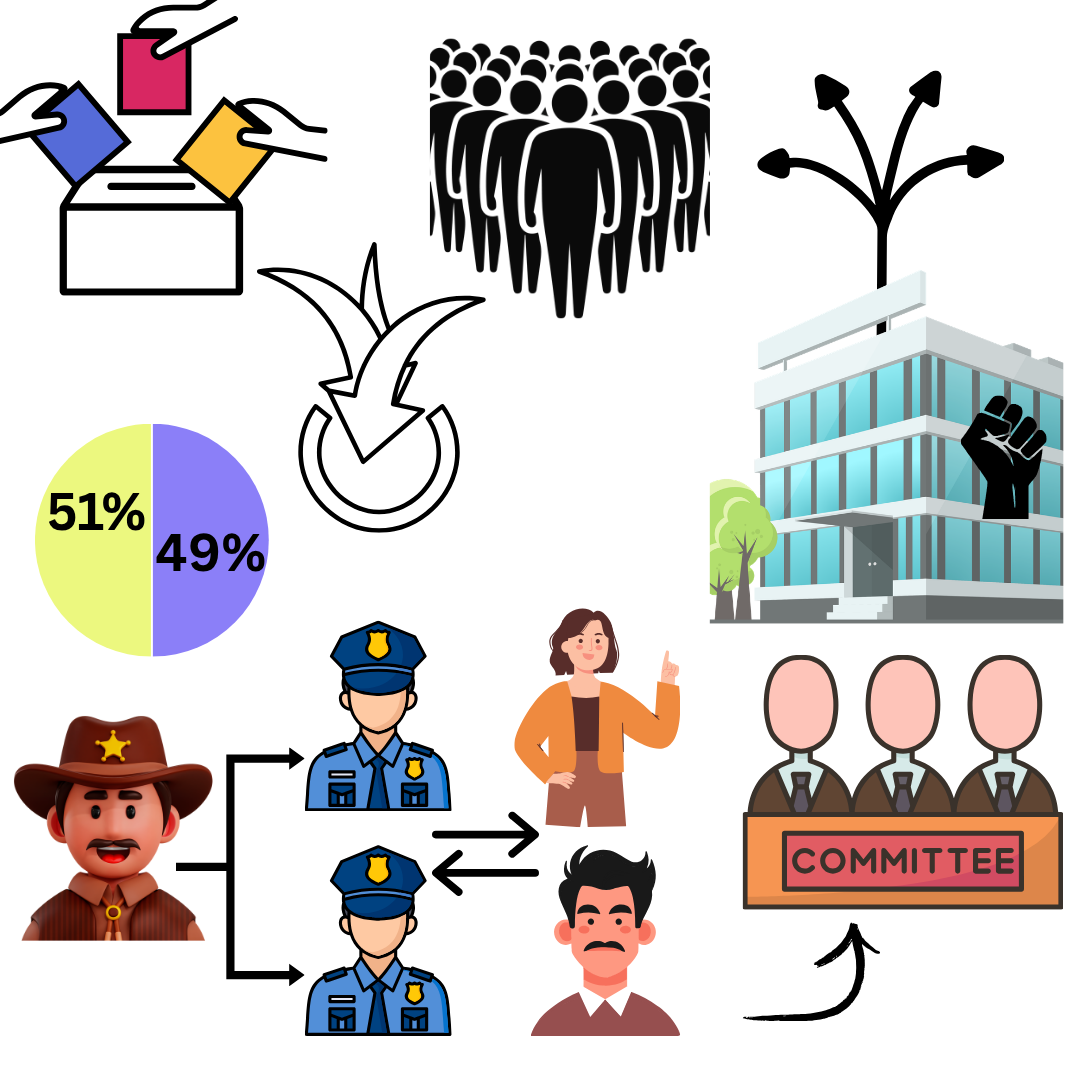
The problem is there is then nothing for parties to do with that information. You can’t directly reward and penalize individual decisions, through 10,000 people participating in one election. Telling 1,000 people which sheriff to vote for, cannot tell an individual cop what to do in an individual situation. The party would need to be able to directly force incentives and penalties on individual cops for individual actions, and can’t.
For non-government formal procedure to work, the party tribunal would have to be able to tell the cop what to do directly, not through the middleman of thousands of voters and the sheriff, who can never know the details of every case.
The first reason elections aren’t used to supervise government employees, is because it’s not even possible for thousands of people to think collectively, to supervise the local decisions of thousands government employees in thousands of events. Having the decisions produced individually in local formal procedures, then telling everyone to parrot and vote based on them, still can’t fix that. Because it still tries to transmit all the decisions through a single vote for a single person.
One election can never make so many choices, or consider more than a few facts. And neither can one elected official.
So the problem with political parties directly supervising government employees is 1) thousands of people in one election, can’t consider more than one or two cases. And even if they could have local formal processes provide that information to them 2) occasional elections of a few officials, can’t directly reward and penalize numerous government employees for individual decisions.
Leave a Reply